August 5, 2026 · Modality
How to Sell Event Tickets Without the Marketplace Fees
Big ticketing marketplaces charge steep per-ticket fees — and keep your buyer. Here’s how to sell from your own event pages for a fraction of the fees and own the audience.
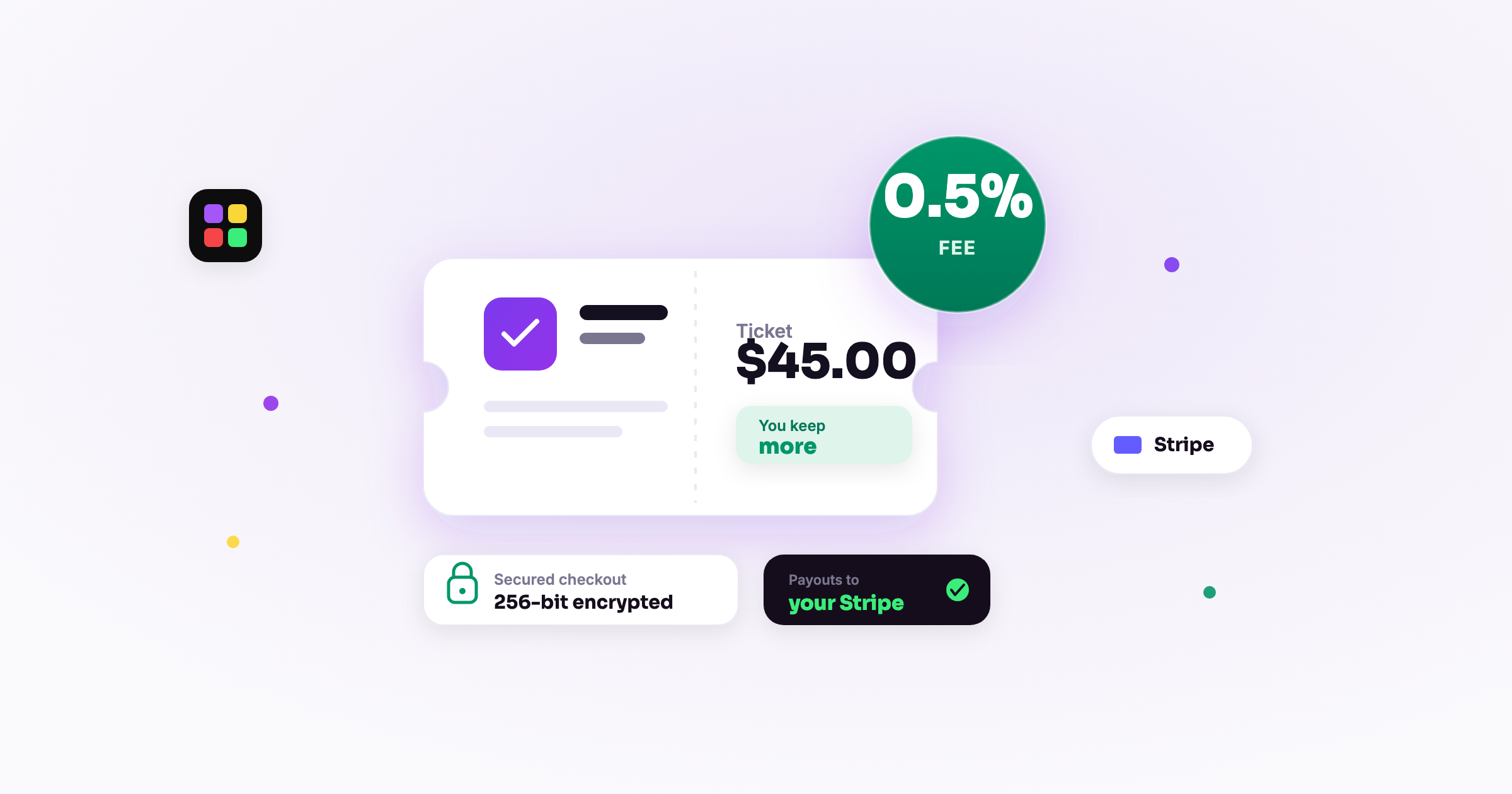
Big ticketing marketplaces charge a steep per-ticket service fee — often several percent plus a flat amount per ticket — then hand you a payout while keeping the buyer. You can avoid that markup by selling directly from your own event page on your own Stripe account. You will still pay Stripe's card processing and a small platform fee, but together they are a fraction of a marketplace's cut — and you keep the customer relationship, which is the bigger prize.
Below is how marketplace fees actually work, why they add up faster than you think, and a step by step way to sell tickets from a page you control. We will run the real math and cover three common cases: a comedy show, a paid class series, and a fundraiser.
How do marketplace ticket fees actually work?
When you sell tickets online through a big ticketing marketplace, you are usually paying two or three layers at once. First there is a per-ticket service fee, often a percentage plus a flat amount (something like 3.7% plus $1.79 per ticket is typical). Second, that platform still has to run the card, so there is a payment processing fee baked in on top. Third, some platforms add a payout or currency fee when the money finally lands in your bank.
The sneaky part is who pays. Many organizers "pass fees to the buyer," which keeps your payout clean but inflates the price on the checkout page. A $25 ticket suddenly reads $29.14 at checkout, and some buyers bounce. Absorb the fee instead and your $25 ticket nets you closer to $22. Either way, someone is paying the marketplace, and it is coming out of the experience you built.
There is a quieter cost too. On a marketplace, the buyer is technically the platform's customer. You often do not get full email access, you cannot easily retarget attendees, and you are one algorithm change away from losing reach. That is a big reason to consider running your own ticketing platform instead of renting one.
Can you sell tickets without a marketplace's fees?
Yes — with one honest caveat: there is no such thing as zero cost to accept a card. Somebody has to process the payment (that is Stripe), and any platform that hosts your checkout and event pages charges something to run. What you can cut is the big marketplace service fee stacked on top — the several-percent-plus-a-flat-amount tax charged on every ticket.
Modality is built for exactly this. You get public event pages with a visual editor, ticket types, promo codes, QR-code tickets, and RSVPs, all wired to your own Stripe account — payouts go straight to your bank on Stripe's normal schedule. Modality's own platform fee is small and transparent: 1.9% on the free plan, 0.9% on Pro, and 0.5% on Business, compared with the roughly 3.7% + $1.79 per ticket a marketplace charges. So you reason about two clear numbers — Stripe's processing rate and a low platform fee — instead of a stack of marketplace charges.
Just as important, the buyer relationship stays yours. Every purchaser flows into your CRM as a real contact you can email, segment, and invite to the next show. That is the difference between renting an audience and building one.
What is the real fee math? A worked example
Numbers make this concrete. Say you sell 200 tickets at $30 each, for $6,000 in face value. We will compare a typical marketplace to selling directly with Modality on your own Stripe account.
The marketplace path
- Service fee: about 3.7% + $1.79 per ticket. On a $30 ticket that is roughly $1.11 + $1.79 = $2.90 per ticket.
- Across 200 tickets: about $580 in fees.
- You either eat that $580 (your payout drops to ~$5,420) or pass it to buyers (they now pay ~$32.90 each).
The own-page path with Modality
- Stripe processing: 2.9% + $0.30 per ticket → about $234 across 200 tickets.
- Modality platform fee: on the free plan that is 1.9% of $6,000 = $114 (it drops to $54 on Pro and $30 on Business).
- Total fees on the free plan are about $348, so your payout is roughly $5,652 — and higher on paid plans.
That is about $230 more in your pocket on a single small event even on the free plan, widening to more than $300 on Business — before you count the value of owning the buyer. Run four events a year and the gap becomes a real chunk of revenue. For a full breakdown of platform costs, our guide to Eventbrite alternatives walks through the trade-offs.
How do you set up your own ticketing in a few steps?
Here is the practical path to sell tickets online from a page you own. It takes an afternoon, not a project plan.
- Connect Stripe. Create or link your Stripe account. This is where payouts land, and you keep full control of refunds and disputes.
- Build the event page. Use the visual editor to add your title, date, venue, description, images, and even a Spotify or Apple Music embed for a music event.
- Create ticket types. Add tiers like Early Bird, General, and VIP. Set quantities and per-tier limits so you can control scarcity honestly.
- Add promo codes. Offer a friends-and-family code or an early-supporter discount without a marketplace taking a slice of every sale.
- Turn on checkout. Buyers pay with a card through Stripe and instantly receive a QR-code ticket for the door.
- Sync to your CRM. Every buyer becomes a contact you own, tagged by event, ready for reminders and future invites.
- Share the link. Put it in your bio, your emails, and your posts. One link, no marketplace listing required.
Because the page and the data live in the same platform, you are not exporting spreadsheets between an own ticketing platform, a CRM, and an email tool. It is one system.
What does this look like for real events?
A comedy show
A weekly comedy night sells 120 seats at $22. On a marketplace, per-ticket service fees quietly add up to a few hundred dollars a month, and the promoter never gets clean email access to laughers who would happily come back. Selling direct on a low platform fee, the same room nets more per show and builds a list that fills the next Thursday without ad spend.
A paid class series
A pottery studio runs a 6-week class at $180 per seat. Marketplace fees on a higher-priced ticket sting more in absolute dollars. With a pay-enabled form or ticketed page on Stripe, the studio keeps far more of each seat's tuition, sees a per-person roster with payment status, and can email the cohort reminders about what to bring.
A fundraiser
For a nonprofit gala, every dollar of fees is a dollar not going to the cause. Selling $75 tickets direct means far more of donors' money reaches the mission instead of a ticketing giant, and the org keeps a real donor list for next year's appeal. Owning that list is the point of building on first-party data.
Why does owning the buyer relationship matter more than the fee savings?
The fee math is real, but the strategic win is bigger. When you sell tickets from your own page, you also capture the buyer relationship: name, email, purchase history, and the tags that let you market smartly. That data is the compounding asset. A marketplace hands you a payout and keeps the customer; your own platform hands you both.
Run it all in one place
Modality brings your CRM, ticketing, forms, payments, and marketing together, with AI that sets it up for you.
Start free