July 15, 2026 · Modality
AI CRM: What It Actually Does in 2026
Every CRM claims to be AI-native now. Here is what AI genuinely does in a modern CRM, and how to tell a real foundation from a checkbox feature.
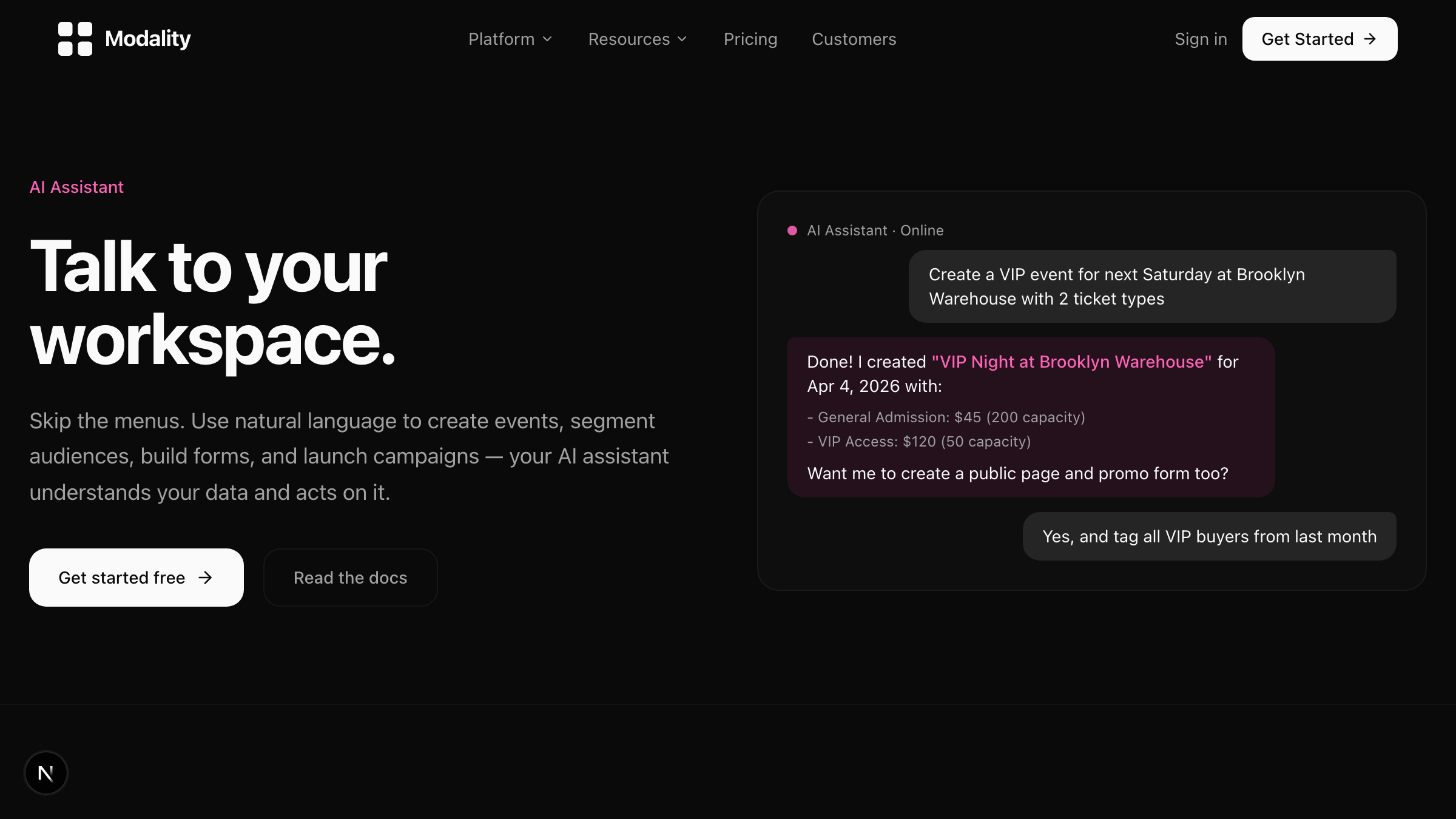
An ai crm is a customer relationship platform where artificial intelligence does real work on your data: setting up your workspace, drafting campaigns in your voice, filling in record fields, and spotting patterns across your business that you would never catch by hand. In 2026, the gap between AI that genuinely helps and AI that is marketing paint is wider than ever, so this article explains what an ai crm actually does, how to tell AI-native from AI-bolted-on, and how to evaluate one before you buy.
What does an ai crm actually do in 2026?
Stripped of hype, a modern ai crm does a handful of concrete things well. It reads your data, generates useful output from it, and takes action so you do less busywork. The value is not a chatbot in the corner; it is AI woven into the tasks you already do every day.
- Builds your workspace from a description. You describe your business in plain language and the AI generates the objects, fields, views, and starter automations to match, instead of making you configure everything by hand.
- Drafts communication in your brand voice. Campaign copy, follow-ups, and event descriptions written from your existing content, so drafts sound like you rather than a generic template.
- Fills and cleans record fields. The AI enriches contacts, suggests tags, and normalizes messy imports, which is the least glamorous and most valuable thing it does.
- Spots cross-module patterns. Because it can see contacts, orders, and events together, it surfaces things like "your repeat buyers all came from one referral source" that no single-purpose tool could find.
Notice what is missing from that list: it does not promise to run your business for you. Good ai powered crm software removes friction from real tasks. It does not replace judgment, and any vendor claiming otherwise is selling the hype, not the tool.
What is the difference between AI-native and AI-bolted-on?
This is the single most important thing to understand, because it determines whether the AI will actually work. The best ai crm software in 2026 is AI-native, meaning the data model was designed so AI can read and write across it. AI-bolted-on means a vendor took a rigid product from the 2010s and stapled a language model onto the side.
Here is why bolted-on falls short. A lot of legacy CRMs use fixed schemas: contacts here, deals there, everything in predefined boxes that cannot easily relate to each other. When you ask AI to reason about your business, it can only work with data it can reach and understand. A rigid 2010-era data model starves the AI, so you get a chatbot that can summarize one email thread but cannot tell you anything about the shape of your business. It looks like AI. It does not deliver like AI.
AI-native systems are built on flexible, connected data from the start. Modality is one example: its flexible objects and linked records mean every person, event, order, and form submission is part of one connected graph the AI can reason over. That is what makes the difference between a novelty feature and a tool you rely on. If you want the fuller argument for why one connected system beats a fragmented one, our piece on all-in-one versus point tools covers it.
What are the real use cases for an ai crm?
Abstract promises are cheap, so here are the concrete jobs an ai crm should handle today, with what each looks like in practice.
Workspace setup from a plain-language description
Instead of spending a weekend building fields and views, you type something like "I run a 200-cap music venue with weekly shows, sponsors, and a mailing list," and the AI stands up the objects, ticket types, and starter automations. You edit from a working draft rather than a blank page. This alone can turn a multi-day onboarding into an afternoon.
Drafting campaigns in your brand voice
An ai powered crm should learn your tone from your existing pages and past emails, then draft new campaigns that sound like you. You still review and edit, but you start from 80 percent done. Modality pairs this with a brand kit so drafts stay on-brand across email, SMS, and social from the campaigns workspace.
Filling record fields and cleaning data
AI for customer relationship management shines at the tedious stuff: suggesting the right tag for a new contact, deduping imports, flagging records missing a phone number. It is unglamorous, but clean data is what makes every other feature work, so this quiet capability is often the highest ROI.
Spotting cross-module patterns
Because an ai-native crm sees your whole workspace, it can answer questions that span modules: which acquisition source produces the highest lifetime value, which event type drives repeat attendance, which segment is going quiet. That cross-cutting view is only possible when the AI can read contacts, commerce, and campaigns together.
How do you evaluate an ai crm before buying?
Marketing pages all sound identical, so evaluate with a short, practical checklist instead of taking claims at face value.
- Test the setup flow. Describe your business in the trial and see what the AI builds. If the output is generic and useless, the AI is likely bolted on.
- Check whether it reads across modules. Ask it a question that spans contacts and sales. If it can only see one silo, it is not AI-native.
- Judge the drafts. Have it write a campaign. Does it sound like you, or like every other AI blurb on the internet?
- Look at the data model. Can you create custom objects and link records freely, or are you locked into fixed contact-and-deal boxes? Flexibility upstream predicts AI usefulness downstream.
- Confirm you keep your data. The AI should make your first-party data more valuable, not lock it away. Ownership and export matter.
You can explore how Modality approaches each of these on its AI features page, then judge for yourself in a trial rather than on promises.
What are the pitfalls of an ai crm?
AI is genuinely useful, but it is not magic, and pretending otherwise leads to bad decisions. Keep these honest cautions in mind.
- Garbage in, garbage out. AI trained on or reasoning over messy data gives messy answers. Clean your imports first; the AI amplifies whatever you feed it.
- Over-automation. Just because AI can send a message does not mean it should send it unreviewed. Keep a human in the loop for anything a customer sees, at least until you trust the output.
- Hallucinated confidence. AI will state a wrong answer as confidently as a right one. Treat its output as a strong draft to verify, not gospel.
- Data lock-in dressed as intelligence. Some vendors use "AI" as a reason to trap your data. Owning your first-party data is what makes AI valuable in the first place, so never trade ownership for a feature.
Where is ai crm software heading?
The direction is clear: from AI that answers questions to AI that does work end to end. The near-term future of ai crm software is agents that watch for a trigger, draft the response, and hand you a ready-to-approve action, so your role shifts from doing the task to approving it. That only works on an AI-native foundation, because an agent needs to see the whole workspace to act sensibly. Vendors bolting AI onto rigid schemas will keep shipping chatbots. The best ai crm 2026 will feel less like a database with a helper and more like a capable operator you supervise.
The practical takeaway: choose your data model with the next three years in mind, not just today's feature list. Flexibility and connectedness are what let AI keep getting more useful as it improves, while a rigid schema caps how smart your tools can ever get.
Frequently asked questions
What is an ai crm in simple terms?
It is a customer relationship platform where AI does real work: building your setup, writing your messages, cleaning your data, and finding patterns across your business. The AI is woven into everyday tasks rather than sitting off to the side as a chatbot.
Is an ai powered crm worth it for a small business?
Yes, if it saves you real hours on setup, copywriting, and data hygiene. Small teams benefit most because AI covers the roles they cannot afford to hire, but only if the AI is native to the data model rather than bolted on.
What makes the best ai crm 2026 different from older tools?
An AI-native data model. The best ai crm in 2026 is built on flexible, connected records the AI can read and write across, so it reasons about your whole business instead of one silo. Bolted-on AI on a rigid schema cannot match that.
Will an ai crm replace my team?
No. It removes busywork and drafts a strong starting point, but judgment, relationships, and final approval stay with people. Treat AI output as a fast first draft to review, not a replacement for a human.
The fastest way to understand an ai crm is to describe your business and watch it build the workspace. Start free with Modality and see what AI-native actually feels like when the AI can see your whole picture.
Run it all in one place
Modality brings your CRM, ticketing, forms, payments, and marketing together, with AI that sets it up for you.
Start free